Every year the strangest thing happens.
No matter how many books I read, no matter how selective I get, I could pick famous or lesser known titles, old or new, long or short, it doesn’t at all change the fact that only a tiny fraction of them (~5%) truly change my mind. It’s never, like, 50%, which would be nice.
On the plus side, it’s always at least a few. And that’s worth all the rest.
Don’t get me wrong, the other 95% are usually good for a good idea. Which is more than worth the cost of each book, but rarely enough to last very long (unless I immediately apply it).
Which is why those top-five-percenters are so exciting. And when I do come across one–and they’re easy to recognize early on– I focus. I take my time, I take notes, I reread chapters, I reflect. And then, when I’m finished, I try to teach it, if I can, to a friend or a lot of friends, and, ideally, ultimately, I try to apply it to my life.
That’s basically why, since 2016, I’ve been writing these posts, trying to learn-by-teaching, which apparently is the best way to learn. It’s for me as much as you. Here are the last four: 39th Year, 38th Year, 37th Year, 36th Year.
This year, my 40th year, I took some from both of those above tiers: the mind-changing 5%ers, and the single-idea 95%ers.
- The Fantastic Four.
- The Rapid Fire Four
Here they are.
–
The Fantastic Four
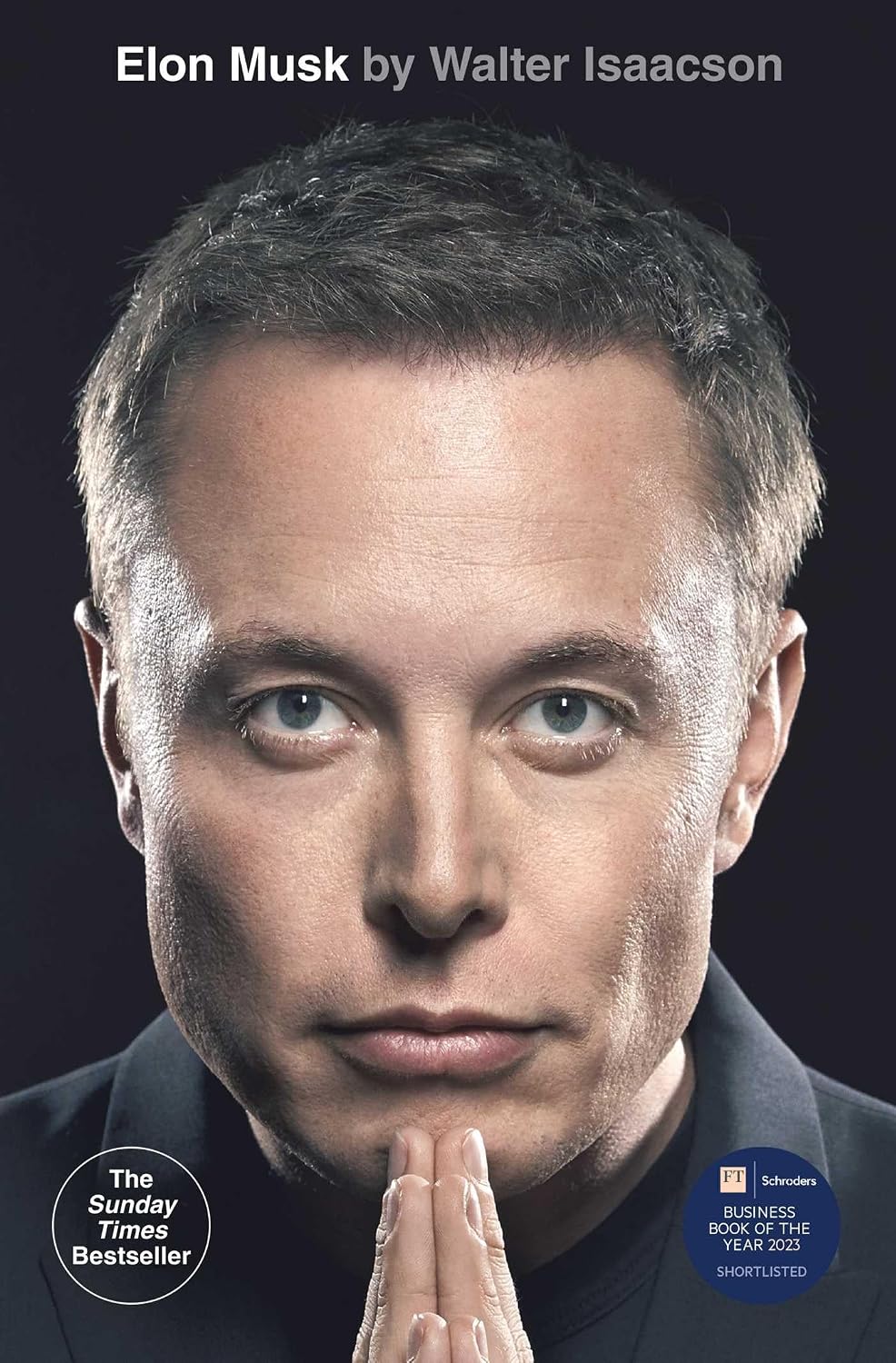
(1) The best book about the best entrepreneur of our (all?) time.
Elon Musk by Walter Isaacson
✅ GOOD AUDIO EXPERIENCE✅
Reading this book is like drinking coffee.
You enter a Musk state of mind. That part of your brain that thinks: “Maybe I could change the world, too.”
Immediately, businesses I could start spring to mind, things to completely delete in your business arise, and huge chances I might take seem obvious and easy. Which is exactly why I read the book in the first place: to learn to be more daringly ambitious.
The book is full of insights and nutty stories, but two lessons stuck out to me most.
Lesson #1: Question Everything.
The Algorithm
Musk runs every business he runs through an equation he calls, “The Algorithm,” or, if you’re super cool, “the algo.”
It’s a five-part framework for avoiding errors and making a business more effective. Frameworks are often bogus, but when probably the single most effective entrepreneur of all time hands you a structure to think through, you should probably consider it.
Not only did I find The Algo head-clearing, but when I started thinking of things through it, I saw improvements to make, not just in my business, but in my life. Here are the five steps.
- Question assumptions and requirements
- Delete as many steps as possible
- Simplify and optimize
- Accelerate
- Automate.
The most important part is to do them in order. Don’t optimize before you question assumptions and delete things because you’ll be optimizing something that’s not that useful. Musk, Isaacson says, made each mistake first. He built The Algo from experience.
And one of the core concepts to come out of it he calls, The Idiot Index.
The Idiot Index
The Idiot Index comes out of the first two steps of The Algo: (1) question the costs (assumption/cost) and (2) delete the parts that are not useful.
“If you do not end up adding back at least 10% of them, then you didn’t delete enough.”
For example, say you’ve sold a few businesses for a few hundred mill and you want to go into rockets–as one does.
You want to buy one, but the thing costs like $100 million. So, rather than just (1) buying cheap stuff or (2) overpaying or (3) giving up, you question how it could possibly cost that much, and then when no good answer comes back, you try to do what Musk does: question the costs.
In this case, say the rocket is made of 1000 parts. You look at all of the raw materials that make each part, and then you calculate that the 1,000 parts all together cost, say, $10,000 raw. But they are $100 million all put together. That difference–the one between the market price assembled thing, and the price of the sum of its raw materials– is what Musk calls the Idiot Index. It represents inefficiency.
“If the ratio is high,” Musk said, “you’re an idiot.”
Lesson #2: Think Big, Act Intently, Believe You Can
The College List and The Vision
But as smart and effective as Musk is, what I love most about him is his ambition, his aspiration, and his willingness, as Arnold says, to Think Big.
In college, at The University of Pennsylvania, Musk was already thinking about the largest problems facing humanity, and how he was going to solve them:
While at Penn, he began to ponder what he called his ‘existential bucket list.’ He tried to think of things that would most affect the future of humanity, and he came up with five: the internet, sustainable energy, space travel (specifically life becoming multiplanetary), artificial intelligence, and rewriting human genetics.
Zip2 (Musk’s first business he started with his brother and sold for ~$300mm) + PayPal were the internet, Tesla and SolarCity cover energy, SpaceX, OpenAI and now Grok for AI, NeuroLink close enough for genetics.
What this shows, I think, are the key things about Musk, and the reason to read this book. First, Musk had a clear, high-aimed vision. He wasn’t moving randomly. Second, he worked towards it, and intently.
Which proves the third, and the requirement: that he believed he could.
Further Reading
If you’re likin’ what you’re hearin’ but don’t want to read a big, bulky bio, first, try to get past that thought. It’s worth it. But second, there are two shorter books on which you can build your courage:
- The Book of Elon by Eric Jorgensen. I’ve probably listened to EJ’s books (The Book of Elon and The Almanack of Naval Ravikant) about 10 times each. Addicting and massively insightful. Grab it on audio, take a walk, and thank me later.
- The Algorithm by Jon McKneil. I have a rule, and that is when one of my favorite thinkers recommends a book, I instantly purchase it. I’ve done this with Tim Ferriss and Seth Godin, as much as I’ve done it with Hemingway and Patti Smith. This book, by an ex-President of Tesla and serial entrepreneur, was highly recommended by Alex Hormozi (wrote about him here), who is one of those thinkers now. If you run a business, read this book, and don’t get some ideas about how to improve it, I’ll buy you a tofu bahn mi. Definite purchase.
(2) The best book about a lawyer-turned-billionaire partner of Warren Buffett
Damn Right: Behind the Scenes With Berkshire Hathaway Billionaire Charlie Munger by Janet Lowe
✅ GOOD AUDIO EXPERIENCE ✅
When Warren Buffett and Charlie Munger started working together, Buffett was already a massive success.
36 at that point, Buffett ran his own investment fund and was worth about $50mm (today’s dollars). That’s why it was so surprising that Charlie Munger completely changed Buffett’s investment style.
Quick back story. Buffett’s guru was Ben Graham, a professor and fund manager that taught value investing. Graham specialized in “cigar butt stocks” – average companies that, for a slew of psychological biases, were very undervalued. Sort of like Money Ball for stocks. Buffett liked that style, learned it, and basically copied it.
Munger, an attorney and property developer with no real investment experience, didn’t love this style. The problem, he told Buffett, was that he was never going to purchase great companies. Great companies are rarely incredibly low prices, as the market can tell they are at least good. But Munger would prefer to pay a fair or even slightly high price for a best-in-class company (one that has a “moat,” they would later say) than a great price for an average company. The advantage would be in the future value of the company, which is where the vast majority of value lies anyway.
Buffett resisted Munger until he finally gave in on an investment into See’s Candy, a company that, over the years, has netted around $2 billion for Berkshire. Not bad for a lawyer.
There were two lessons I drew from this.
The Lessons
#1 Outsiders can look in.
Munger is famous for his broad reading habits (everything from the classics to physics to history to art) and his strong, independent thinking, and that’s what was on display here. Can you imagine telling a multimillionaire expert investor with a bulletproof track record that you think his thesis is flawed?
To me, it’s a good reminder to think for myself. Of course, you have to allot some respect to experts or you’re just making the opposite mistake, but as the outsiders, we can also possess something the experts have long-lost–The Beginner’s Mind. We have a unique perspective exactly because we are novices, not in spite of that fact.
For me, I hope, this can apply in the areas of health and fitness. I’m not a doctor, nutritionist, trainer, or psychologist, and yet I’ve been writing a book over the past six years on how to get yourself to be healthy forever.
But to exercise that opinion, you need two additional traits, which are hard to balance.
To be courageous (telling someone nicknamed The Oracle of Omaha that his expertise needed an upgrade) and, like Buffett, to be humble. Because in some things, we’re the experts who could use some influence.
Which is part two of the lesson.
#2 Insiders should look out.
It’s just as impressive that Buffett listened to Munger. That’s humble.
It’s a skill to be influential, but maybe a more subtle skill to be influenceable. To be an apparent expert, and be open to the idea that you have a blind spot that a non-expert can see.
It makes me think of areas where I’ve developed expertise, and to be wary of thinking I know too much. And also to ask for feedback from those smart, independent-thinking novices who might be able to see around corners that I cannot.
Further reading
For more Munger, pick up Poor Charlie’s Almanack, a compilation of speeches and interviews you can come into and out of over a long period of time. Great bathroom book. Also, listen to interviews with Munger. They’re insightful and highly entertaining.
For Buffett, I loved The Snowball slightly more than I enjoyed Roger Lowenstein’s book.
(3) The best biography of “the most powerful figure in comedy” (history?)
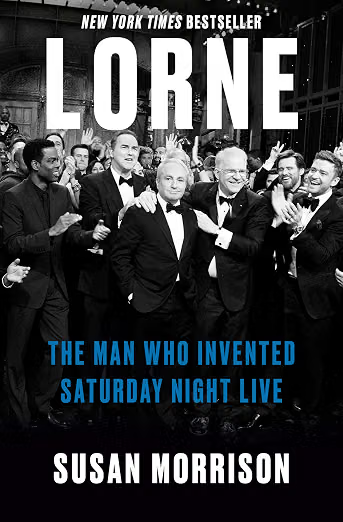
Lorne: The Man Who Invented Saturday Night Live, by Susan Morrison
✅ GOOD AUDIO EXPERIENCE ✅
This story is incredible.
- A Canadian kid, fascinated by the arts, adopts a local celebrity as his mentor, pursues comedy, producing and directing from early age.
- He suffers the sudden loss of his father, creates a comedy duo, eventually performing on Canadian cable, catches the attention of agents, mentors and peers.
- He moves to LA with very few connections, creates some out of nothing, writes, produces, and directs all manner of odd jobs, some successful, some not, works his way into a conversation to take on a new experimental show at NBC called Saturday Night Live.
- He dives in to SNL, makes it successful, leaves for five years, it falls apart, he comes back, puts it back together, and goes on for the next five decades creating an American institution that impacts basically everyone in comedy and entertainment in the next half century.
That’s all in this book, and it’s a long, awe-inspiring story. But here are the three lessons I took from it.
(1) Master the basics, first. All of them.
When you’re a beginner in a field, it’s easy to get swayed by those sexy contrarians who do things differently than “it’s supposed to be done.” What’s wrong with run-on sentences? Faulkner does it.
But what you find when you read tons of biographies (and I’ve read well over 100) is that most of those contrarians started off by learning everything they could about the fundamentals. Only after they build up a storehouse of knowledge do they branch out.
Before Einstein upended Classical Physics, he was tutored, rigorously, on the fundamentals. If you’ve ever read a James Joyce novel (or tried to) you might not realize that nutty style was born of someone trained in the classics, Latin, and grammatical stringency.
SNL was a groundbreaking show, but to rise to where he needed to be to direct it successfully, Lorne Michaels had to go through each level of show business.
He had a mentor in his teen years, acted in and produced plays in his teens, created a live comedy duo in his 20s, wrote on corny TV shows in his mid-20s, produced and directed documentaries and variety shows in his late 20s. By the time he was 30, Michaels had accumulated nearly two decades of performance, writing, comedy, acting, and directing experience from every which way, including live.
So that when NBC’s Dick Ebersol was looking for a new edgey show, Barry Diller even suggested Michaels. And it’s also how Michaels knew it had to be live– he knew what it was like, and about the corny alternative.
(2) Major in the minors.
Recently, Brian Chesky of AirBnB and Mark Zuckerberg have been getting some publicity for their “founder mode” approach.
This is when the CEO, against convention, micromanages little details of the company at different times. “I basically don’t believe in delegation,” Zuck said. “If you’re running the company and you’re on the hook for everything and there’s something that’s important at whatever level of detail in the company, I don’t get the logic of saying ‘I’m not going to be involved in it.”
Lorne lives by the same code. He, still, 50 years later, makes all the scene decisions in the show, up and through airtime every single week. It’s an insane amount of detail that he gets into. (Musk is the same).
Of course, there is a downside to this, which is that a lot of the core decisions live and die through Lorne. If he’s not there, they can’t happen. But, particularly when its in an area of importance to the outcome, and the creator / founder has developed unique taste, it seems like the right path to me.
(3) Go where the thing is
Lorne grew up on the same street as a successful comedic actor who became his mentor.
He taught Lorne about theatre, comedy, timing, and taste. He provided the tools and direction that eventually led Lorne to starring in his own comedy duo, which was eventually picked up by Canadian TV. But, even though this mentor was famous, you don’t know him.
And that’s because of an important decision he never made.
Lorne made the choice that Frank Shuster didn’t. To go where people become famous: Los Angeles. Shuster decided to stay in Canada and raise a family. Lorne wanted, not just to be great, but well-known. Both rose to the ceiling of their environments.
The lesson is obvious: go to the best environment for your thing. If you’re fast, but you’re running on sand, you’ll limit your top speed. Find a bouncy track, and you’re going to be much, much faster.
If you can’t get there physically, join an online group of peers, like MrBeast did, but do something to get in the scene.
(4) The best business-focused novel of all-time
The Goal: A Process of Ongoing Improvement by Eliyahu M. Goldratt
✅ GOOD AUDIO EXPERIENCE ✅
The Constraint
This is probably the novel most recommended by entrepreneurs, and it changed the way I look at my business.
It’s by a physics professor who helped a friend of his turn around his manufacturing plant with a very simple but profound idea: a business only moves as effectively as its least effective part. He calls that part, “the constraint.”
The core insight: any time spent working on anything else in a business not the constraint was a complete waste of time. Put another way, in any system, one single thing limits your output. Effort spent elsewhere much less impactful.
A basic example is a chain. A chain is exactly as strong as its weakest link. Strengthening any other link adds nothing to the chain’s ability. Not a little; nothing.
If nine links are made of metal, and one is made of string cheese, and then you upgrade every other link to Adamantium, how much have you increased the chain strength? Zero. Achilles is immortal in all parts but his heel. So that’s where the arrow is aimed.
This becomes harder to see the more complex the system, like a business. What exactly is the thing that prevents it from moving forward? That’s the constraint.
Address that, and only that. All else is a distraction.
My Constraint
After reading this book, it was clear to me what was preventing movement in airfare snacks, the healthy snack service I cofounded.
We were working on a whole bunch of things at the same time, but the business wasn’t growing as fast as we wanted. Why? Because we were spending a lot of time improving things that were not the constraint. We improved the website, and the snack selection, and the shipping operation, and the packaging.
But the thing that was not moving fast enough was the thing that was the limiting factor: demand. Not enough people knew about our thing.
Even if the shipping team was at 100% efficiency, it didn’t help us sell more product. They didn’t have enough orders to fulfill. The only thing that would push the system forward was focus and reinvestment into marketing. The weakest link. So we did that. And, as Goldratt would have expected, it started to move.
I then saw the personal applications. The book I’m writing had a key constraint. My relationships had one. Even, my body. Chasing 10% body fat, I noticed that a lot was going really well in most areas, but where I would screw up was overeating calories at night. Not just at night, like between the hours of 7-9. 90% of the day was perfect, less than 10% stalled progress.
What Goldratt showed me was (1) that disproportionate impact is common and (2) spending time elsewhere was dumb.
So why isn’t the booked called, “The Constraint?”
Because a constraint only exists relative to The Goal. This is critical. Change your target, and the bottleneck moves.
So first, choose a goal, and stick to it. Then, find out the one thing that is dragging it or preventing it from progress. Then, put all of your attention into that block, and nothing else. Once that is cured, others will arise. Fix them, in order.
Further Reading. A lot of what Musk talks about and what The Algorithm talks about are based on this theory. Another person that is very constraint-oriented is Alex Hormozi, so you can read $100 Million Dollar series (Offers and Leads).
Rapid Fire Four
(1) Feel The Fear and Do It Anyway by Susan Jeffers (Self-Help)
This book is all about that feeling of uncertainty when you don’t know the direction to move.
Jeffers says there’s one reason that successful people move forward, and others freeze:
- Freezers think: “I don’t know what to do, so I’ll stay still.”
- Successful people think: “I’m not sure what to do or what will happen. And I’m scared. But whatever happens, I’ll handle it.”
If you think you will handle it, Jeffers says, you’ll move forward, despite not knowing. I’ve found this to be true.
“IF YOU KNEW YOU COULD HANDLE ANYTHING THAT CAME YOUR WAY, WHAT WOULD YOU POSSIBLY HAVE TO FEAR? The answer is: NOTHING!”
“Every time you encounter something that forces you to “handle it,” your self-esteem is raised considerably. You learn to trust that you will survive, no matter what happens. And in this way your fears are diminished immeasurably…Remember that underlying all our fears is a lack of trust in ourselves.”
(2) The Great CEO Within: The Tactical Guide To Building a Company by Matt Mochary
Mochary is a performance / business coach of top people like Sam Altman, top managers at Sequoia, and the CEO of Reddit.
One single idea that stood out (and I actually did this with Geremy, my biz partner) was the Energy Audit.
The idea is that you’ll do your best work by far in tasks that are energy generating rather than sapping. If that’s true, you should, to the greatest extent possible, get rid of the tasks that make you feel depleted. To do that, you have to identify those tasks and change them.
Here’s how it works:
- Look at last week, for example, and hour by hour write what you did.
- Then, put a green dot next to the “energy-giving” tasks and a red dot “energy-draining” ones.
- Make your next weeks more green and less red by deleting or delegating red tasks, and focusing on green tasks that drive the business (or your life) forward
“Your goal as a leader is to maximize the percentage of time you spend doing things that give you energy, and minimize the time spent doing things that drain you.”
(3) Maybe You Should Talk To Someone by Lori Gottlieb
A therapist goes through a major relationship crisis (her boyfriend leaves her unexpectedly) and, in her heavy grief, hires a therapist for herself.
The book is about her going through that experience, while also seeing patients of her own, only to realize that we all have the same core problem. This duality made it a really interesting read, seeing the common issues we all struggle with through the inside and outside of an expert.
One takeaway: A lot of pain comes from fighting the reality that we refused to acknowledge or accept. If you can force yourself to see it and accept it, you can overcome it, or at least be content living with it.
A few favorite quotes:
People will do anything, no matter how absurd, to avoid facing their own souls.
Changing our relationship to the past is a staple of therapy. But we talk far less about how our relationship to the future informs the present too. Our notion of the future can be just as powerful a roadblock to change as our notion of the past
The inability to say yes, however—to intimacy, a job opportunity, an alcohol program—is more about lack of trust in oneself. Will I mess this up? Will this turn out badly? Isn’t it safer to stay where I am?”
(4) Who is Michael Ovitz? by Michael Ovitz
This book almost was a top book. Ovitz was a cofounder and the driving force behind CAA, and a former President at Disney. One of the most successful non-actors in Hollywood history.
But, to me, it was a little too self-indulgent, and that took away from the book. That said, I got a lot out of it.
I’ll offer you three quick hitters:
- Equal partnership. CAA diverged from William Morris (where Ovitz started) by making all five cofounding agents equal partners with pooled commission. The WMA model was that “you eat what you kill.” Ovitz says that CAA’s equal partnership made the five move more as a unit, like a great sports team, than an every-man-for-yourself status shop. That made the second thing possible.
- Package deal. Ovitz was influenced by Lew Wasserman, an old time Hollywood great, who pioneered the idea of not pitching clients for roles, but pitching entire packages to studios– the actors, writers, screenplays, and directors. This took way more work and time, but it flipped the balance of power from the studios to CAA. And to last all that time, he needed the third thing: belief and will.
- Something from nothing. Some projects, Ovitz and CAA stayed with for 5-10 years before they were made. That takes will and belief, two things Ovitz had by the barrel. If you want to get a bit more of those, read this book.
“Nothing in Hollywood is anything until it’s something, and the only way to make it something is with a profound display of belief. If you keep insisting that a shifting set of inchoate possibilities is a movie, it eventually becomes one. Sometimes.
One for the road: How to do great work
I loved this famous lecture called “You and Your Research,” by Richard Hamming on how to do great and impactful work by one of the top computer scientists out of the famed Bell Labs.
Not surprisingly, it was recommended by Paul Graham, who wrote the single best thing I read last year.
Quotes I liked:
“Given two people with exactly the same ability, the one person who manages day in and day out to get in one more hour of thinking will be tremendously more productive over a lifetime.”
“Most people like to believe something is or is not true. Great scientists tolerate ambiguity very well. They believe the theory enough to go ahead; they doubt it enough to notice the errors and faults so they can step forward and create the new replacement theory.
“If you do not work on an important problem, it’s not likely that you’ll do important work.”
“I notice that if you have the door to your office closed, you get more work done today and tomorrow… But 10 years later somehow you don’t quite know what problems are worth working on… He who works with the door open gets all kinds of interruptions, but he also occasionally gets clues as to what the world is and what might be important.”